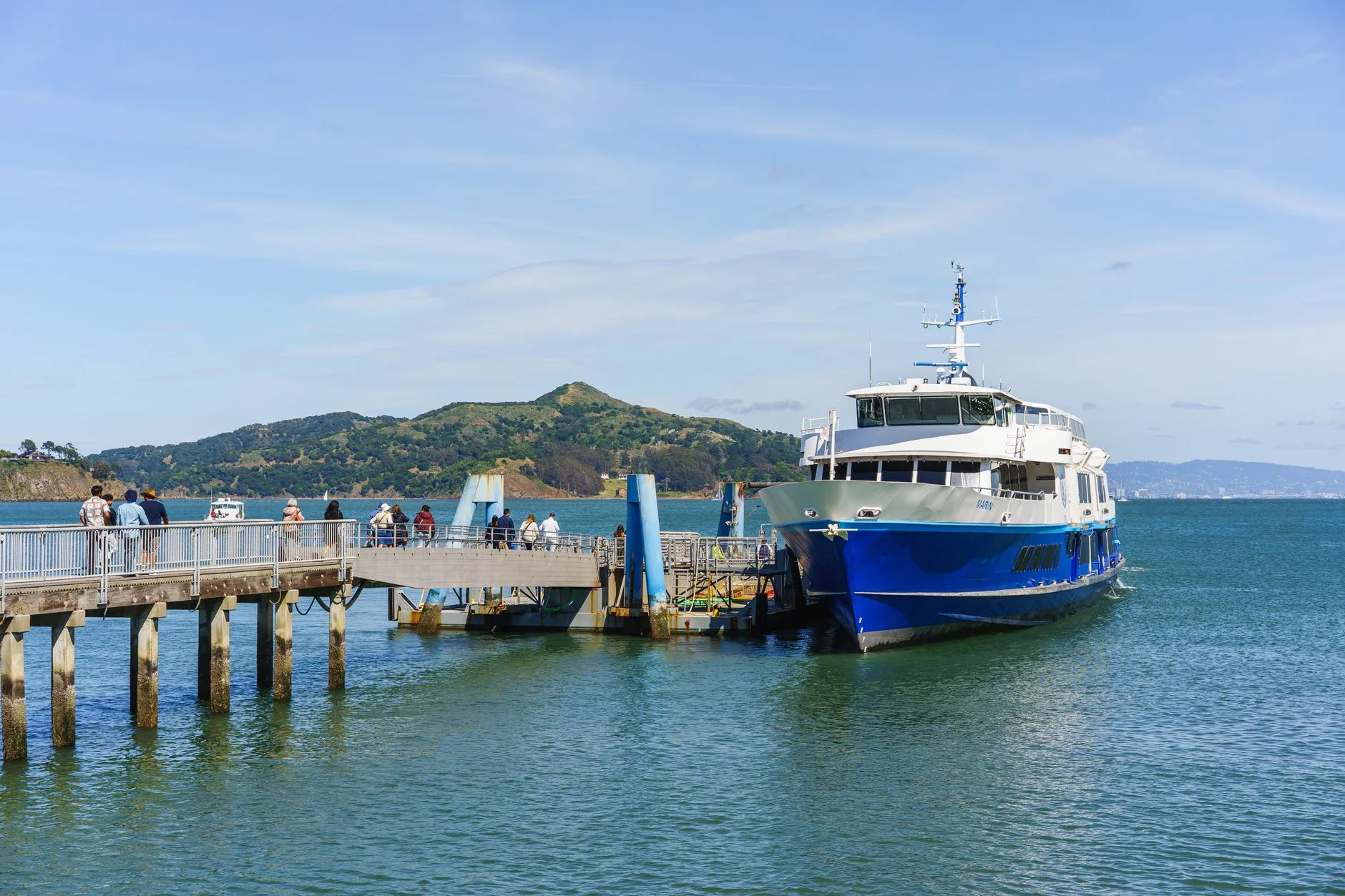
The scope the transportation agency records
The Treasure Island Mobility Management Agency is building transit shelters, public restrooms and support spaces at the island ferry landing. The San Francisco County Transportation Authority runs the agency. Its project page describes the work as part of a Transit Hub and lists two grants behind it: $3 million from a Federal Highway Administration program and $1 million from California's Affordable Housing and Sustainable Communities program.
The July 2025 board memo carries the detail. The construction allotment runs to $3,199,350, split $2,335,600 federal and $863,750 state. Construction engineering adds $550,650 and preliminary engineering $250,000. The three phases total $4 million.
The corner the landing occupies
The Transit Hub sits at the southwest corner of Treasure Island, at the point where the causeway joins Yerba Buena Island. The memo lists its parts: the ferry terminal, a public plaza, and bus stops for Muni, a future on-island shuttle and future East Bay service.
Treasure Island Community Development designed and built the terminal and the plaza. The same group operates an interim ferry service today. The transportation agency is adding the passenger-comfort layer on that design.
The 2011 environmental report for the redevelopment set the shape of the facility. It called for a terminal with shelters for bus and shuttle transfers and an area for ticket sales and travel information. The agency states its objective as passenger comfort, safety and access to the island network.
What changes at the arrival moment
A guest who lands at the ferry landing steps off a boat and walks. The operator states that accessible pathways connect the landing to the island's parks, neighborhoods and gathering spaces. The package in construction adds shelter, a restroom and places to sit at that point.
For a hotel holding luggage ahead of an afternoon check-in, the change is practical. A guest arriving before the room is ready gains a sheltered place to wait with a toilet within reach. A guest leaving hours after checkout gains the same hold point. Front desk staff can name the terminal and give a reason.
A property that sells the island as an excursion can hand a guest that hold point at both ends of the day.
Five dollars, no Clipper card
The ferry runs seven days a week between the island landing and the San Francisco Ferry Building at Gate B. The fare is $5 per ride, or $10 round trip. Children under five ride free. Tickets come from the ferry app, the terminal, or a credit card or cash at the boarding gate. The service does not accept Clipper.
Two travel times are published. The operator's ferry page gives an average of eight minutes. Its getting-here page gives about ten minutes. Either figure holds when the page behind it is named.
Each ferry carries up to six bicycles per trip on a first-come, first-served basis. Ferries and terminals are accessible, with boarding support for riders who need it. On-board charging of mobility devices is prohibited.
The evening limit
Weekday departures from the island run from 7:30 a.m. to 8:00 p.m. The last boat leaves Gate B at 8:20 p.m. and reaches the island at 8:28 p.m. The Saturday timetable is published separately on the operator site.
Muni route 25 covers the hours the ferry does not. It runs from the island to the Salesforce Transit Center and along the Embarcadero every 20 minutes, every day. The operator names it as the alternative when a service disruption or a cancellation affects a trip.
The operator adds sailings between 10:30 a.m. and 4:30 p.m. on Saturdays when the Off the Grid market runs.
The arrival note a property can send
The full note fits in four lines. Ferry from Gate B, eight to ten minutes, $5 each way, no Clipper. Muni 25 every 20 minutes as the backup. Last island departure 8:00 p.m. on weekdays. Bikes on board, six per trip.
The note covers the outbound leg, the return leg and the missed boat.
What the record does not say
The construction contract went to Thompson Builders Corporation at $3,047,000, against an engineer's estimate of $2,950,000. One bid arrived on the 3 June 2025 opening date. The federal Disadvantaged Business Enterprise goal was 22 percent. The contractor committed 2.6 percent, and Caltrans accepted the good faith effort. No protest arrived in the five-day window.
The schedule reads award in July 2025, construction start in September 2025, completion in Summer 2026. The project page carries Fall 2025 for the start and Summer 2026 for completion. The page's most recent archived capture, 10 June 2026, still lists Summer 2026. No source reachable for this report records the work finishing or a revised date.
No source publishes a shelter count, a restroom stall count, a floor area or a passenger figure for the landing. The project page carries one contact, info@timma.org.
The hotel rooms still unbuilt on the island
The redevelopment entitlements allow up to 500 hotel rooms across Treasure Island and Yerba Buena Island. The environmental record carries the figure. No hotel has opened on either island. The operator's venue page lists nine event venues and no lodging property, and the development group publishes no hotel schedule.
San Francisco hotels serve this traffic from the mainland side today. A guest crossing for a market, a tasting room or a waterfront event leaves from the Ferry Building and returns to it. The terminal work shortens the wait at both ends. The island room count stays at the entitlement figure.